N.v. · Work · Evidence first

What the work
actually produces.

One verified client outcome first. Then three clearly marked composite scenarios showing the reports, dashboards, and system maps the work can produce.

Anonymous service-business client · verified outcome

64%

increase in qualified leads reached within one business hour after implementation.

One real outcome

Every inquiry had an owner. Every estimate had a next step.

Before

  • Leads split across phones, email, and website forms
  • No owner or next date on an estimate
  • Lost work was never counted

After

  • Every inquiry enters one shared intake
  • Automatic acknowledgement within minutes
  • Stale estimates surface before they die

Additional examples

Three ways the work can take shape.

These scenarios are composites, not client claims. They make the process and deliverables concrete without presenting invented results as proof.

01.

HVAC service & install · 9-person team illustrative

A whiteboard that only one person could read, and a phone that rang after five.
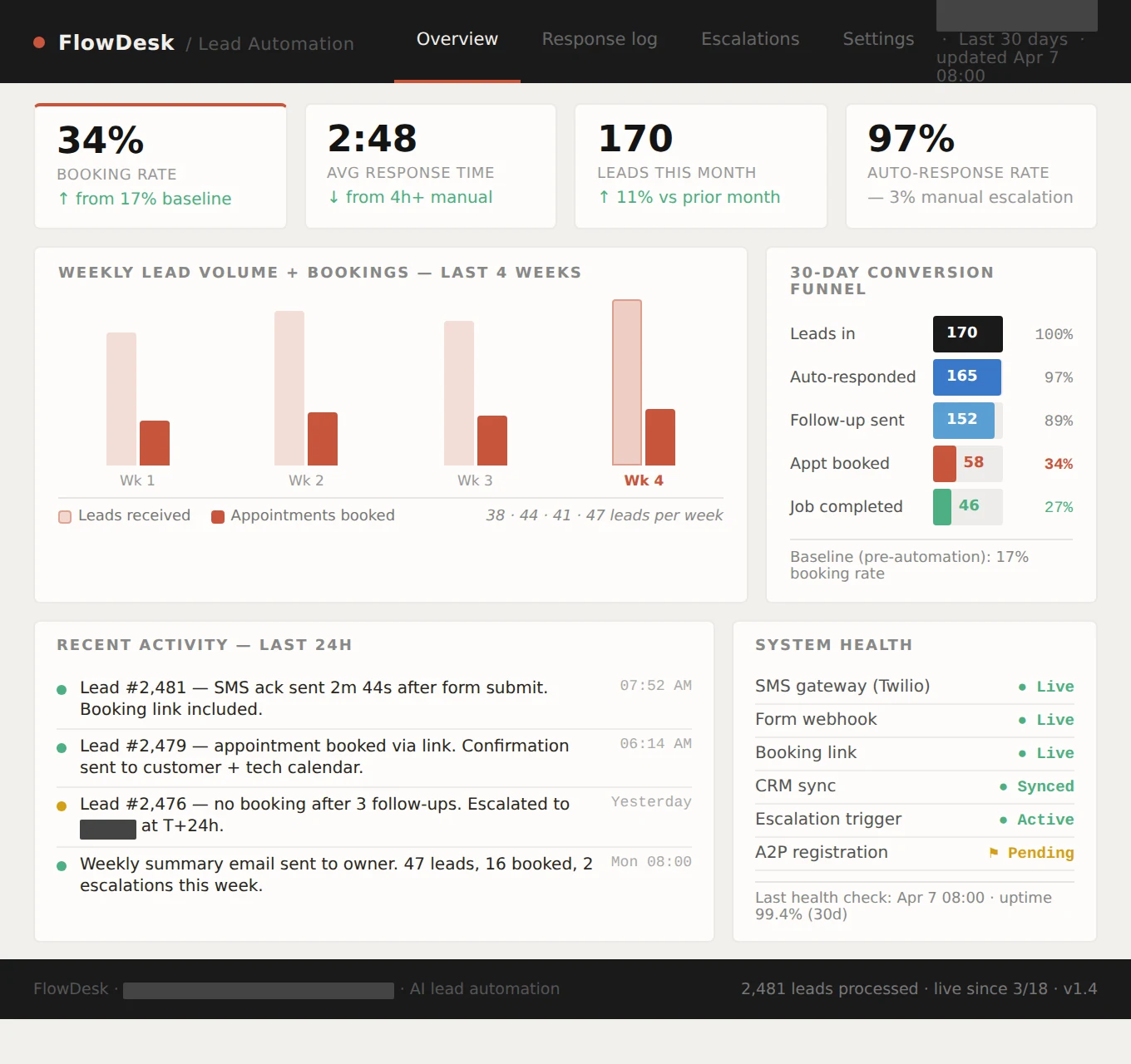
Booking dashboard showing 34% booking rate, 2:48 average response time, and a 30-day conversion funnel.
Booking + response dashboardBooking rate and response time stop being a feeling and become a number somebody owns.

Dispatch lives on a whiteboard and in the dispatcher’s head. It works, right up until she is out, and then the morning is spent reconstructing the day from call history. Nobody can say how many calls came in after hours, because nothing records them — they either reached someone or they did not.

Booking moves online with confirmation and a reminder before the window, so the customer stops being the reminder system. After-hours calls are captured and triaged instead of lost, and the day is visible to more than one person.

The point is not the automation. It is that the business stops depending on one person being available, and starts being able to count what it was previously only guessing at.
Typical2 weeks
ScopeBooking · Dispatch · After-hours
MeasureThe day survives one absence
02.

Roofing company · 4-person team illustrative

Leads arriving through three different channels. No system. No follow-up.

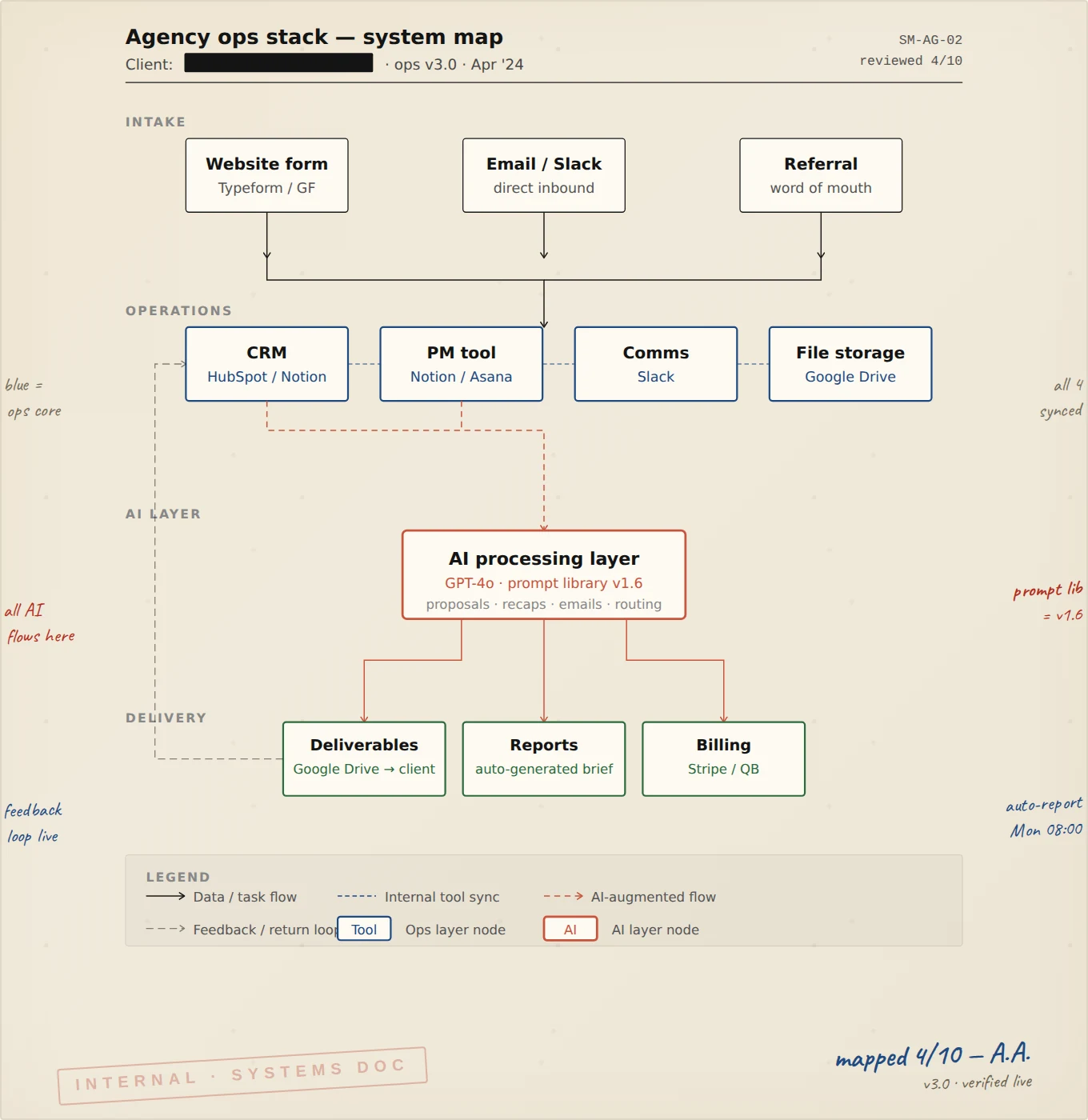
Hand-annotated system map showing three intake channels consolidating into a single operations core.
System map — intake to deliveryThree intake channels, one pipeline. Drawn before anything was built, and kept current after.

A four-person roofing company takes job enquiries through a website form, two personal mobiles and a shared Gmail. If the right person does not see the message first, nobody follows up. Underneath that sit three overlapping subscriptions — a CRM nobody adopted, a project tool from a vendor demo two years ago, and a scheduler from a promotion everyone has forgotten about.

The fix routes every channel into one intake with a same-day acknowledgement that does not wait for a human, and a pipeline — lead, estimate, job, complete — the whole team can see. The overlapping tools get itemised against what they actually do, and the duplicates are cut.

The change worth measuring is not response time. It is that duplicate spend becomes a line item instead of a direct debit nobody reads, and a lead going cold leaves a record — so what slow follow-up costs across a season can be counted rather than felt.

Typical3 weeks
ScopeLead routing · Pipeline · Cleanup
MeasureDuplicate spend, itemised
03.

Insurance agency · 12-person office illustrative

Shared logins, passwords on sticky notes, and a vendor pitching them AI they didn't need.

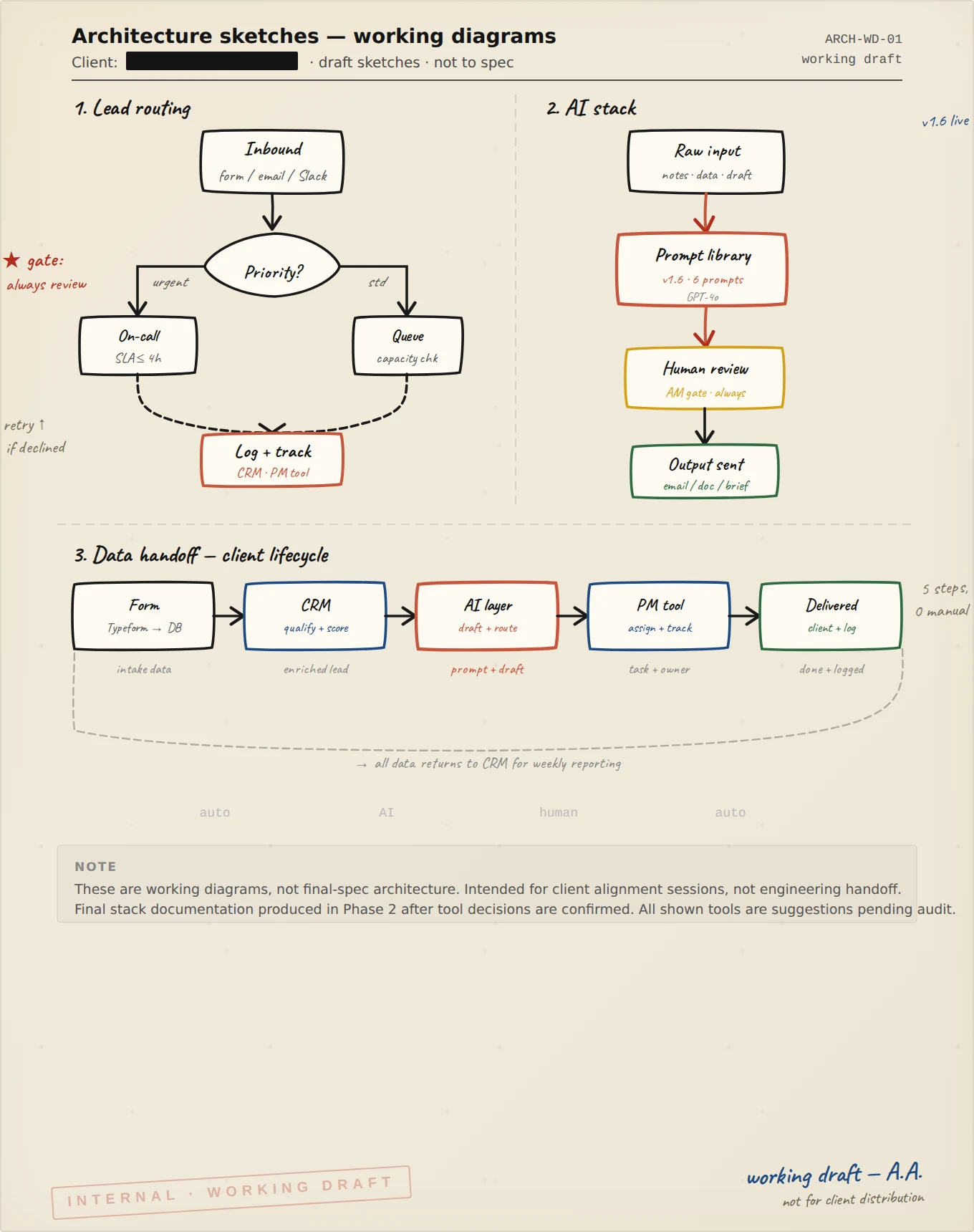
Architecture diagram of the document workflow and access control layout.
Access + document workflowIndividual logins, a managed password vault, and a document route that used software they already owned.

A regional insurance agency runs most systems on shared credentials, with passwords on notes near the monitors and no reliable way to end an account when someone leaves. At the same time a vendor is pitching an expensive AI document-processing product for policy applications.

Access comes first: individual logins, a password manager across the team, and an offboarding checklist so access ends the day someone leaves. Then the pitch gets tested rather than accepted — the job being sold can usually be done with the Microsoft 365 licences already on the invoice and a properly configured document route, with no new AI spend.

The point is not the automation. It is that the access exposure closes, and the buy-or-not decision gets made against what the stack already does rather than against a demo.

Typical5 weeks
ScopeSecurity · Workflow · Automation
MeasureAccess ends the day someone leaves

Sites & products I've built.

Website design is a service — it helps to see what that looks like in practice.

Scroll to explore →

Working in a specific field?

Ready to do this for your business?

If you saw something in one of these stories that looks familiar, that's where we start. Book a call and we'll figure out what to fix first.